Kratom was originally a freely exportable commodity. However, the dominance of raw kratom exports prompted the government to encourage downstreaming and increase the added value of kratom exports.
The kratom plant has long been a subject of controversy. The National Narcotics Agency (BNN) categorizes kratom leaves as containing addictive substances due to their potential to cause addiction, euphoria, and nausea/vomiting when used in high doses.
Kratom leaves (Mitragyna speciosa) are native to Southeast Asia, particularly Indonesia, Malaysia, and Thailand.
In Indonesia, kratom grows abundantly in Kalimantan, especially along the Kapuas River. Kratom leaves contain two main active compounds, mitragynine and 7-hydroxymitragynine, which have analgesic or pain-relieving effects.
This plant has long been used by people in Southeast Asia, including Indonesia, to address various health issues such as pain, fatigue, and digestive disorders. Consequently, many health and pharmaceutical manufacturers have shown interest in utilizing kratom as a raw material for herbal medicines.
Former Indonesian President Joko Widodo even held a limited meeting at the Presidential Palace last year to discuss the legalization of kratom. At that time, President Joko Widodo asked the Ministry of Health (Kemenkes), the National Research and Innovation Agency (BRIN), and the Food and Drug Supervisory Agency (BPOM) to further 1 investigate the benefits and risks of kratom.
This is because Indonesian kratom is considered to be of the best quality in the world. Kratom was originally a freely exportable commodity. However, the dominance of raw kratom exports prompted the government to encourage downstreaming and increase the added value of kratom exports.
The economic value of kratom exports during 2018-2023 is very promising. According to data from the Central Statistics Agency (BPS), from January to May 2023, the value of kratom exports increased by 52.04 percent compared to the same period of the previous year, reaching USD 7.33 million. During the same period in 2023, export volume grew by 51.49 percent compared to the same period in 2022. This indicates a continuous positive trend.
This economic potential was evident when Minister of Trade Budi Santoso released the inaugural export of kratom produced by CV Cahaya from Pontianak, West Kalimantan, worth USD 1.05 million or approximately IDR 17 billion. The release of 351 tons of kratom in 13 containers took place at PT Oneject Indonesia, Cikarang, Bekasi Regency, West Java, on Friday, (February 28, 2025). This export also marked the first kratom export since the implementation of the kratom export trade system, whose regulations were issued in late 2024.
The kratom trade system is officially regulated by the Minister of Trade Regulation (Permendag) Number 20 of 2024 concerning Goods Prohibited for Export and Permendag Number 21 of 2024 concerning Export Policies and Regulations. Both Permendag regulate the kratom commodities that can be exported and those that are prohibited.
The exported kratom, in powder form, can be processed into various health and herbal products. The Minister of Trade stated that the moment of releasing the kratom export has been eagerly awaited by business actors.
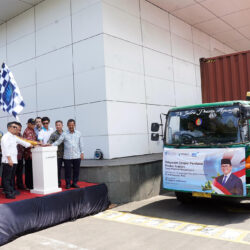
Minister of Trade, Budi Santoso
“I appreciate all parties who have synergized to realize the kratom export trade rules, thus providing benefits to kratom farmers and exporters. Congratulations to the kratom business actors who have succeeded in penetrating the international market by meeting the export standards set by the government.”
In this export, PT Oneject Indonesia acts as a provider of kratom sterilization or irradiation services, which are utilized by kratom business actors in preparing exports. This ensures that kratom products meet international standards. Considering that many kratom products from Indonesia are rejected by the export market due to not meeting these criteria.
To maintain its quality, especially during export, quality resilience is needed, particularly against pathogen contamination. A sterilization process with e-beam technology is required as a standard to maintain this quality. Kratom export verification also involves PT Sucofindo as an independent testing, inspection, and certification (TIC) institution.
Minister of Trade Budi Santoso stated that exportable kratom is in the form of cuts, crushed, or powder, with a maximum size of 600 microns. This standard is used to guarantee the quality of exported Indonesian kratom.
“This effort is taken by the government to provide added value and increase the selling price of Indonesian kratom,” said the Minister of Trade.
A representative of kratom farmers, Agus Widhiyanto from the Borneo Natural Produce Management Community Group Association (Kompar), said that the kratom export trade system is beneficial in maintaining the quality of kratom exports. Maintained quality is an important factor in preventing kratom exporters from suffering losses after shipment.
Writer: Kristantyo Wisnubroto
Editor: Untung Sutomo
This article has been translated from the original Indonesian version.
Source:
https://indonesia.go.id/kategori/keanekaragaman-hayati/9060/potensi-ekonomi-dan-polemik-khasiat-daun-kratom