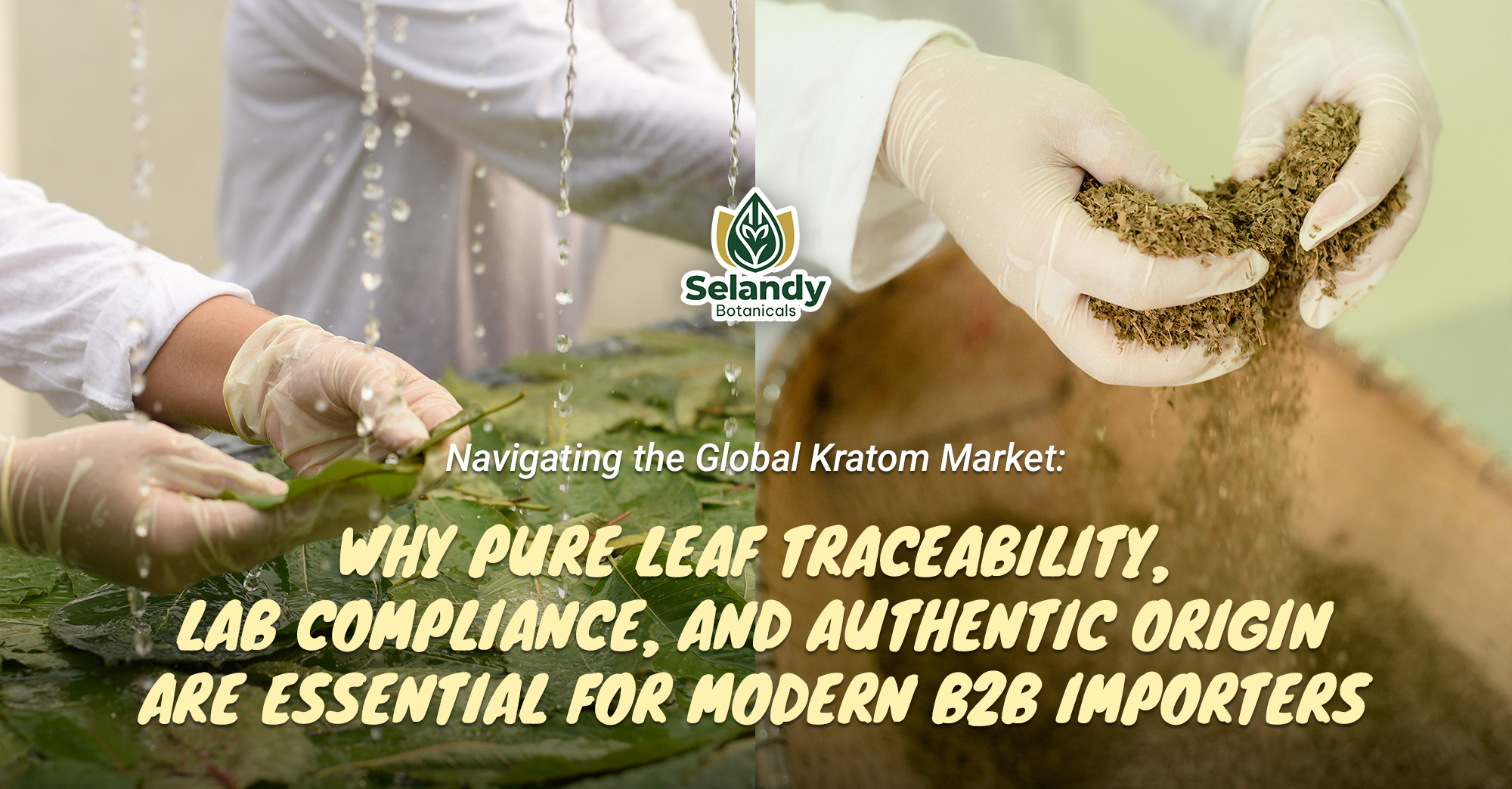
The global kratom trade is moving into a more demanding phase. For wholesale distributors, supplement brands, and importers in North America and Europe, price and availability are no longer enough to build a reliable supply chain.
Buyers increasingly need to know exactly what they are purchasing, where it was produced, how it was processed, and whether every batch can be supported by credible laboratory documentation. This shift is particularly important as regulatory scrutiny around kratom and concentrated kratom-derived compounds continues to intensify.
In the United States, the FDA’s current Import Alert 54-15 specifically covers dietary supplements and bulk dietary ingredients that contain Mitragyna speciosa or kratom, including powdered leaves, whole leaves, extracts, and other forms. The agency uses detention without physical examination for shipments covered by the alert.
That environment is changing how serious B2B buyers evaluate suppliers. Traceable origin, pure leaf sourcing, laboratory testing, and documented quality controls are becoming fundamental commercial requirements rather than optional extras.

The Modern Regulatory Landscape Is Changing Buyer Priorities
One of the clearest trends in the international kratom market is the growing separation between naturally sourced leaf products and highly concentrated or chemically altered products.
In 2026, U.S. regulators have increased attention on 7-hydroxymitragynine and synthetic kratom-related compounds. The FDA has specifically highlighted products containing concentrated or non-naturally occurring compounds as an area of concern, while the DEA began a temporary scheduling process involving 7-OH above a proposed threshold and several synthetic derivatives.
For importers building long-term brands, this creates a strong incentive to understand the composition and origin of every raw material.
A professional procurement strategy increasingly centers on:
- 100% natural Mitragyna speciosa leaf powder
- Clearly documented country and regional origin
- Batch-specific laboratory testing
- Consistent mitragynine levels and alkaloid profiles
- Transparent processing and drying procedures
- Full traceability from source to shipment
This does not mean that a natural leaf product is automatically legal or compliant in every destination. Kratom rules differ between countries, states, and product categories, so importers remain responsible for checking the requirements that apply to their specific market.
Quality and Safety Benchmarks Start With the Raw Leaf
Laboratory compliance is one of the most important differentiators between an established botanical supplier and an unverified reseller.
Raw plant material can be affected by environmental conditions, harvesting practices, drying conditions, storage, transport, and handling. A professional supplier therefore needs a quality system that addresses both identity and contamination risks.
Heavy Metal Screening
Heavy metals such as lead, arsenic, cadmium, and mercury are key contaminants that buyers may require to be screened in botanical raw materials.
Testing should be performed through appropriately qualified laboratories, with results linked to specific production batches. For B2B customers, a laboratory report is much more useful when it can be matched to the exact material being shipped rather than presented as a generic certificate from an unrelated production lot.
Microbiological Testing
Microbiological control is equally important for powdered botanicals. Poor drying, moisture exposure, unsanitary processing environments, or improper storage can increase the risk of contamination.
A serious quality program should address organisms such as E. coli and Salmonella, along with other relevant microbiological parameters defined by the buyer’s specification and destination-market requirements.
For private-label supplement companies, this level of documentation can also simplify internal quality assurance, supplier qualification, and batch-release procedures.
Consistent Alkaloid Preservation
Quality is not only about removing contaminants. It is also about preserving the natural characteristics of the leaf.
Harvest timing, drying temperatures, moisture control, storage conditions, and processing methods can influence the final alkaloid profile. Buyers seeking consistent mitragynine consistency should therefore ask suppliers how the leaf is harvested, dried, milled, stored, and sampled.
A consistent production process provides a stronger foundation for repeat purchasing than simply selecting the lowest-cost batch available.
Why Direct Sourcing Matters
The supply chain between Indonesian farms and international buyers can involve several layers of traders, brokers, aggregators, processors, and exporters.
Every additional layer can create another point where information may be lost or material may be mixed.
Direct sourcing offers greater visibility into the origin of the raw material. When an exporter works closely with native Indonesian cultivators and manages processing closer to the source, buyers can obtain clearer information about harvesting areas, processing practices, and production batches.
This can also reduce unnecessary middlemen costs.
For a wholesale customer purchasing hundreds of kilograms or more, even modest efficiency gains throughout procurement can materially affect landed cost. More importantly, direct relationships can make quality problems easier to investigate because the supplier has a clearer connection to the original production network.
Traceability Is Becoming a Commercial Advantage
Traceability is often discussed as a compliance concept, but for B2B buyers it is also a business tool.
A traceable batch allows an importer to answer practical questions quickly:
- Which farm or sourcing region produced the leaf?
- When was it harvested and processed?
- Which laboratory tested the batch?
- What were the microbiological and heavy metal results?
- What was the measured alkaloid profile?
- Which shipment and production lot contained the material?
This information becomes particularly valuable when a buyer is supplying multiple downstream customers or maintaining strict supplier approval procedures.
For brands operating in competitive North American and European markets, a documented chain of custody can strengthen customer confidence and reduce dependence on anonymous commodity sourcing.
Choosing a Reliable B2B Botanical Supply Partner
A credible supplier should be able to discuss quality specifications in practical terms rather than relying on broad marketing claims.
When evaluating a pure kratom bulk supplier, importers should look for evidence of:
Origin Verification
The supplier should clearly identify Indonesian origin and explain how raw leaf is sourced and aggregated.
Batch-Level Documentation
Certificates of analysis should correspond to actual production lots. Generic test reports should not be treated as equivalent to batch-specific documentation.
Laboratory Coverage
Ask whether the testing program includes alkaloid analysis, heavy metals, microbiological screening, and other contaminants relevant to the intended application.
Production Consistency
A reliable supplier should demonstrate repeatable harvesting, drying, milling, packaging, and storage procedures.
Export Experience
International shipments require more than product availability. Documentation, packaging, customs requirements, logistics coordination, and destination-country compliance all matter.
Indonesia itself has an active export-control framework for kratom. For example, Indonesia’s Ministry of Trade set an export-right percentage of 25% of production capacity for the July–December 2026 period.
This is another reason buyers should work with an authentic Indonesian kratom exporter that understands the domestic supply environment as well as international shipping requirements.

Building a More Reliable Kratom Supply Chain
The strongest B2B supply relationships are built around consistency rather than one-off transactions.
For importers, the objective should be a documented supply chain where the material is identifiable, testable, repeatable, and commercially predictable. That means moving beyond questions such as “What is your price per kilogram?” and asking more important questions about origin, specifications, laboratory controls, processing, and documentation.
As the global market becomes more closely scrutinized, businesses that can demonstrate genuine product provenance and disciplined quality management will be better positioned to serve demanding wholesale customers.
Selandy Kratom Farm: Direct Indonesian Sourcing for Global B2B Buyers
For international buyers looking for a dependable source of Indonesian kratom, Selandy Kratom Farm is positioned around the principles that increasingly matter in modern botanical procurement: authentic origin, controlled sourcing, laboratory verification, and dependable wholesale supply.
By working closer to the Indonesian source, Selandy Kratom Farm addresses the challenges created by fragmented supply chains and uncertain product provenance. Its focus is on providing high-grade Indonesian kratom for professional B2B buyers seeking greater consistency, clearer traceability, and reliable supply.
For distributors, supplement brands, and importers evaluating a pure kratom bulk supplier, the right sourcing partner is not simply the one offering the lowest price. It is the supplier that can help build a reliable, documented, and sustainable supply chain from Indonesian leaf to international destination.
In a market where authenticity, laboratory compliance, and traceability are becoming increasingly important, choosing an experienced source can make the difference between a commodity purchase and a dependable long-term botanical supply relationship.