Choosing a kratom supplier is not simply a purchasing decision. For international buyers, it is a supply-chain decision that can affect product consistency, import documentation, customer requirements, and the long-term reliability of an entire business.
A professional supplier should be able to answer practical questions about origin, processing, testing, documentation, production capacity, and export procedures. The goal is not to find the supplier with the lowest quoted price. It is to identify a supplier that can provide dependable material and verifiable information over time.
For companies sourcing Indonesian kratom for wholesale distribution, private-label manufacturing, or botanical product development, proper supplier due diligence should take place before the first large shipment.

Why Supplier Due Diligence Matters
The kratom supply chain can involve farmers, local collectors, processors, laboratories, exporters, freight providers, and overseas importers. Every additional step can affect how information is recorded and how consistently a product reaches its final buyer.
Indonesia remains central to the international kratom trade, particularly West Kalimantan. At the same time, Indonesian export requirements have developed significantly, making documentation, processing, and export controls increasingly important for commercial buyers.
A supplier evaluation process helps buyers distinguish between a company that simply resells material and one that has a structured operation behind its products.
10 Questions to Ask a Kratom Supplier Before Ordering
1. Where Does Your Kratom Actually Come From?
Start with the simplest question: what is the geographical origin of the material?
A credible supplier should be able to explain whether its kratom comes from a defined sourcing region, specific farming communities, or a network of growers in Indonesia. Buyers should be cautious when a supplier provides only broad claims such as “premium Indonesian kratom” without explaining how the raw material enters its supply chain.
Origin information becomes particularly valuable when consistency matters across repeated orders.
2. Do You Source Directly or Through Multiple Intermediaries?
The number of intermediaries between farm and exporter can affect both traceability and purchasing economics.
A direct or closely managed sourcing model may give an exporter better visibility into harvesting, drying, and raw-material selection. A supplier relying entirely on anonymous third-party material may have less control when a batch does not meet specification.
This does not mean every intermediary is unreliable. The important issue is whether the supplier can explain how it maintains control over incoming material.
3. How Do You Control Batch Consistency?
Two shipments described with the same product name may not have identical characteristics.
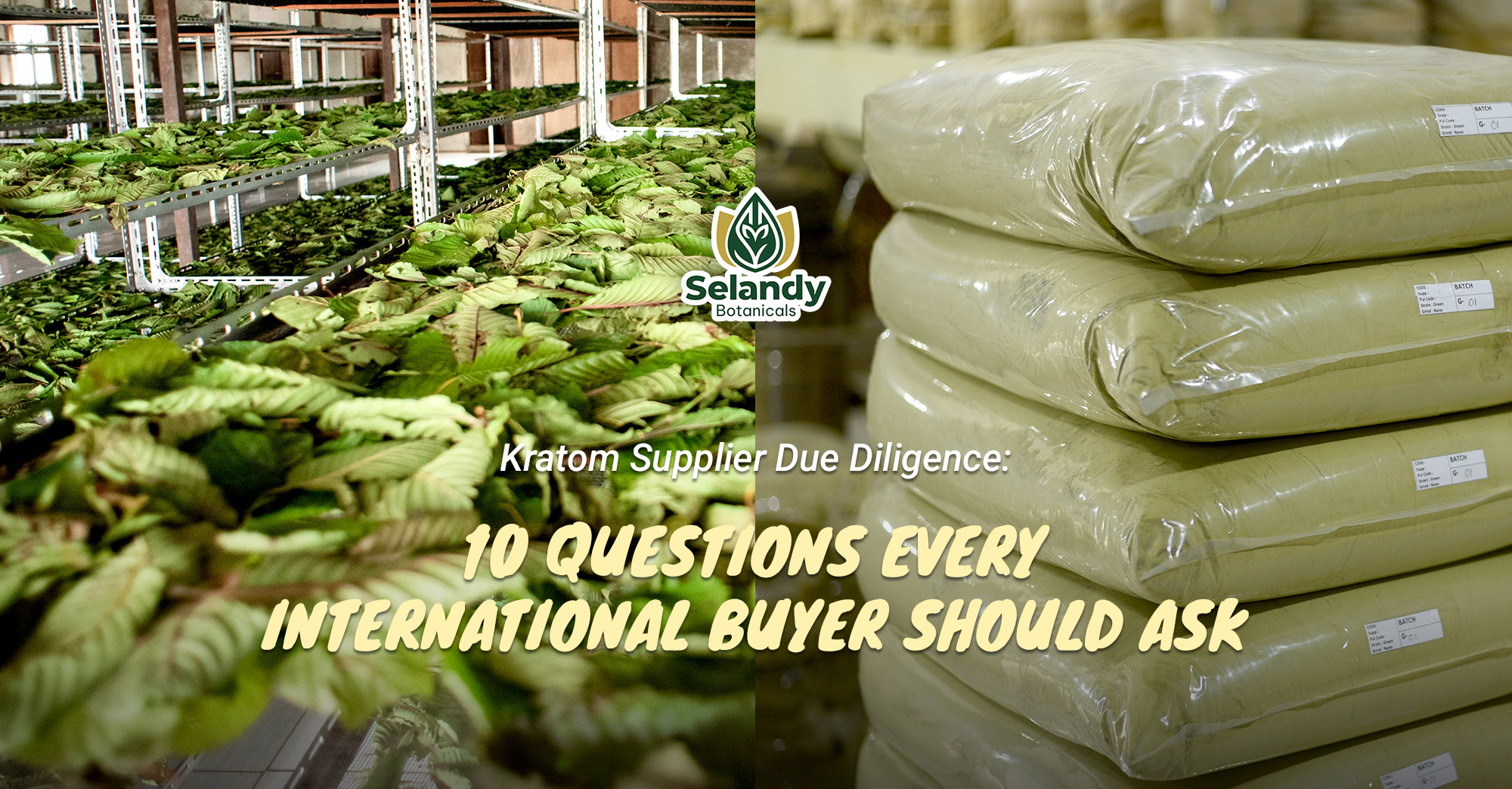
International buyers should ask how a supplier manages variables such as moisture, milling, storage, raw-leaf selection, and natural alkaloid variation. A professional supplier should be able to explain its production standards rather than treating every shipment as interchangeable commodity material.
Consistent specifications are especially important for wholesalers and brands that need predictable incoming raw material.
4. What Laboratory Tests Are Performed on Each Batch?
“Lab tested” is useful only when buyers understand what was actually tested.
Ask for a clear testing panel and determine whether the results correspond to the specific production batch being purchased. Depending on the buyer’s requirements, testing may include alkaloid analysis, microbiological screening, heavy metals, pesticides, or other contaminants.
A Certificate of Analysis should support the material being shipped, not merely demonstrate that the supplier tested kratom at some point in the past.
5. Can You Provide a Verifiable Certificate of Analysis?
A COA should be treated as a quality document, not a marketing image.
Check the batch number, testing date, laboratory identification, analytical methods, and measured results. When possible, buyers should establish that the document relates directly to the lot under consideration.
This is particularly important for lab-tested wholesale kratom, where downstream customers may require documentation as part of their own supplier qualification process.
6. How Is the Leaf Harvested, Dried, and Processed?
Processing conditions can influence the quality and consistency of botanical material.
Ask the supplier how freshly harvested leaves are handled, how drying is controlled, and how material is protected from moisture and contamination during milling and storage. Good process control should reduce avoidable variation between production lots.
For B2B buyers, understanding the process is often more informative than relying on strain names or promotional descriptions alone.
7. What Is Your Actual Production Capacity?
A supplier may have an attractive sample but struggle to support larger recurring orders.
Before moving into a wholesale relationship, ask how much material the supplier can realistically process and ship within a normal production cycle. Also ask how capacity changes during periods of high demand or seasonal supply variation.
The objective is to determine whether the supplier can support your business after the first order, not just win the initial purchase.
8. Which Export Documents Can You Provide?
International botanical trade involves more than packaging a product and handing it to a freight company.
Ask the exporter what commercial and shipment documentation it normally provides and which party is responsible for export procedures, customs paperwork, testing documentation, and logistics coordination.
Requirements can vary by origin and destination, so importers should independently confirm the rules applicable to their own market. Indonesian kratom exports are subject to domestic trade controls, and recent policy developments have placed additional attention on processed-form exports and export capacity.
9. What Happens If a Batch Does Not Meet Specification?
This is one of the most revealing questions a buyer can ask.
A professional supplier should have a clear procedure for handling material that fails an internal or customer specification. That may involve additional testing, segregation, rejection, reprocessing where appropriate, or replacement.
The answer tells buyers a great deal about how seriously the supplier treats quality control.
A supplier focused only on closing the sale may discuss quality when everything goes well. A reliable B2B partner should also be prepared to explain what happens when something goes wrong.
10. Can You Support Long-Term B2B Purchasing?
The final question is about the relationship rather than the product.
International importers need suppliers that can communicate clearly, maintain agreed specifications, provide documentation consistently, and plan production around repeat orders.
A strong wholesale relationship should become easier to manage over time. Product specifications should remain clear, documentation should become routine, and both parties should understand expectations around lead times, packaging, testing, and shipment preparation.

Red Flags That Should Not Be Ignored
Supplier due diligence becomes much easier when buyers know what signals deserve additional attention.
Be cautious when a supplier:
- Cannot clearly explain the origin of its raw material
- Provides only generic or outdated laboratory documents
- Avoids discussing production and processing practices
- Makes unrealistic claims about availability or pricing
- Cannot explain its export documentation process
- Changes product specifications from one conversation to another
- Is unable to describe what happens when a batch fails testing
None of these points automatically proves that a supplier is unsuitable. They indicate that the buyer should ask more questions before committing to a significant purchase.
Building a Supplier Evaluation Process
For larger importers and distributors, supplier selection should not depend on one conversation or one sample.
A useful evaluation process can compare suppliers across several areas:
- Origin and traceability
- Laboratory testing
- Production consistency
- Documentation
- Export experience
- Capacity
- Communication
- Commercial terms
- Response to quality issues
- Long-term supply capability
This approach allows purchasing teams to compare suppliers using consistent criteria rather than selecting a company based primarily on price or attractive product descriptions.
What Modern B2B Buyers Should Expect
The international kratom market is becoming more professional. Buyers increasingly need reliable documentation, consistent material, and suppliers that understand the responsibilities associated with cross-border botanical trade.
For a wholesale distributor or private-label brand, the real cost of choosing the wrong supplier can extend far beyond the original purchase price. Delayed shipments, inconsistent batches, missing documents, rejected material, and customer complaints can quickly outweigh a small difference in supplier pricing.
The better approach is to evaluate the supplier before evaluating the quote.
Selandy Kratom Farm: Built Around Reliable B2B Supply
For international buyers seeking an authentic Indonesian kratom exporter, Selandy Kratom Farm focuses on the practical requirements that matter in a long-term B2B relationship.
The objective is straightforward: provide reliable access to Indonesian kratom while supporting buyers with clear sourcing information, quality-focused processing, laboratory documentation, and dependable wholesale service.
For importers and distributors searching for a pure kratom bulk supplier, supplier due diligence should always come before large-volume purchasing. Asking the right questions at the beginning can help create a more predictable supply relationship later.
The strongest supplier relationship is not built on a single low-price quotation. It is built on consistent material, transparent information, responsible processing, and the ability to deliver according to agreed specifications.